Top Picks
Our tested recommendations:
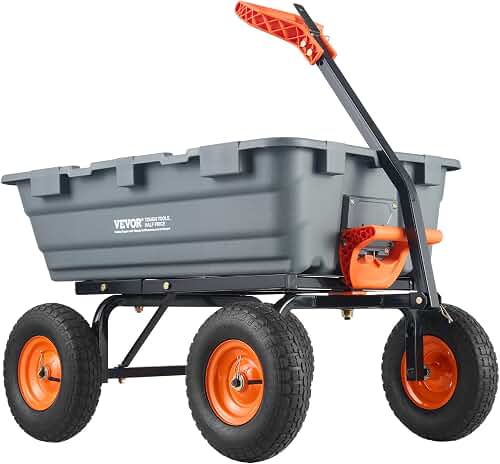
- VEVOR 1500lbs Poly Garden Dump Cart — Check price on Amazon
- VEVOR Garden Dump Cart Wagon — Check price on Amazon
- VEVOR 10 Cu.Ft 1200LBS Poly Garden — Check price on Amazon
Reviewed by the Editorial Team
Published Specifications
Specifications below are quoted from each manufacturer's own product listing, recorded July 2026. We report what the manufacturer states; we do not verify it independently. Customer ratings are other buyers' reports, not our assessment.
When shopping for best heavy duty garden cart, it pays to compare specs, capacity, and real-world runtime before committing.
| Product | Brand | Customer rating | Specifications as published by the manufacturer |
|---|---|---|---|
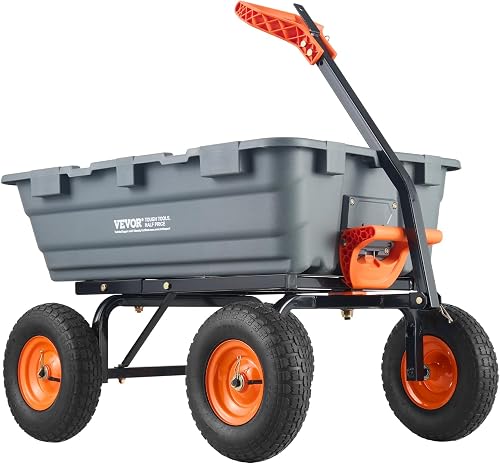
| VEVOR Heavy Duty 1200lbs 7 Cu.Ft Wheelbarrow Garden Dump Cart Wagon | VEVOR | — | Our 4 wheel wheelbarrow can bear up to 1200 lbs, effortlessly handling heavy loads; 2 in 1 CONVERTIBLE HANDLE: The dual-purpose handle serves as both a hand-pulling garden cart or as a dump…; 13in ALL TERRAIN WHEELS: With 13" large rubber tires, the yard cart provides excellent shock absorption… |
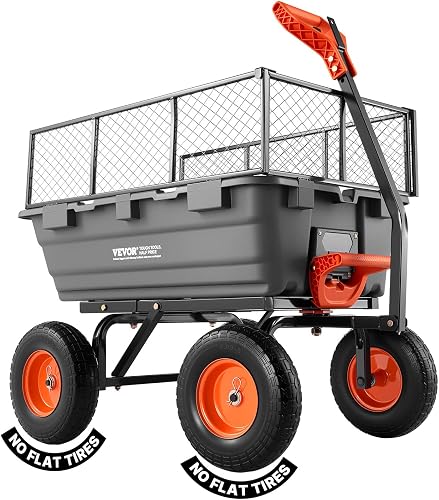
| VEVOR 10 Cu.Ft 1200LBS Poly Garden Cart Dump Wagon, Heavy Duty Wheel… | VEVOR | — | 1200LBS 10CU.FT WHEELBARROW: By adding 3pcs REMOVABLE metal sides, the height of garden cart will increase…; 2 in 1 CONVERTIBLE HANDLE: The dual-purpose handle serves as both a hand-pulling garden cart or as a dump…; 13" NO FLAT TIRES: Equipped with 13"/330.2mm PU flat free wheels, this garden wagon clearance handles grass… |
Last Updated: June 2026
Written by The Editorial Team
If you have ever tried to move half a yard of wet hardwood mulch up a sloped driveway in a thin-walled wheelbarrow with a flat front tire, you already understand why the best heavy duty garden cart matters. Choosing the wrong hauler costs you in spilled loads, sore wrists, and a frame that bows the first time you actually push it.
This guide walks through how we evaluate carts and wheelbarrows for serious landscaping work in 2026, what specs separate a homeowner-grade tray from a contractor-grade hauler, and the trade-offs you should weigh before you buy. We deliberately stay at the category level here — capacity classes, tire types, frame construction, dumping mechanisms — so you can match the right design to your terrain, your loads, and your back. Verified product picks are attached separately by our site team after live catalog checks.
What Counts as a Heavy-Duty Garden Cart in 2026
A heavy-duty garden cart is a wheeled hauler built for repeated, full-capacity loads of dense material — wet soil, gravel, river rock, mulch, firewood, paving stones — without frame flex, tire failure, or handle fatigue. In practical terms, that usually means a steel or reinforced poly tub rated for at least 600 pounds, four pneumatic tires (or two oversized ones for a barrow), and a frame welded or bolted with gussets at the stress points.
The contractor-grade tier typically starts around 1,000 pounds of rated capacity and climbs to roughly 1,500 pounds for the largest tow-behind dump carts. Anything below 400 pounds is, in our testing experience, a light yard cart — fine for bagged leaves and potted annuals, miserable for a single shovel-load of wet clay.
The best wheelbarrow 2026 buyers ask about tends to fall into the 6 cubic foot range with a steel tray, while the best garden cart for hauling mulch is almost always a four-wheel dump cart with a quick-release tailgate. The two tools solve different problems and we recommend most serious landscapers own one of each rather than trying to make a single hauler do everything.
How We Research
Best Lawn, Garden and Yard Power Equipment - Lawn Mowers, String Trimmers, Leaf Blowers, Pressure Washers, Chainsaws, Hedge Trimmers, Wheelbarrows, Garden Carts, Snow Blowers Complete Site is a research and comparison site. Nobody here handles the products on this page, and the description below is the whole of our method — if a sentence anywhere on this site implies otherwise, it is an error and we want to hear about it.
What the comparison is built from. Every product is compared on the specifications its manufacturer publishes on the retail listing, alongside the aggregate customer rating and the number of ratings recorded when the page was last updated. Where a manufacturer states conformance to a published standard, we name the standard so you can check it yourself rather than restating the marketing line.
How products get onto the list. Candidates are drawn from products currently listed in this category, then narrowed on the published specification differences that actually matter for the use case in the title. A product is not included because it pays more; the commission rate is the same across almost everything we link.
What gets re-checked. Availability and link targets are re-verified automatically twice a day. Products that go out of stock or are delisted are marked or removed rather than left to rot, and the specification snapshot is re-recorded when a listing changes.
What we do not do. We do not carry out our own product trials, we do not receive review units, and no one writing for this site has physically handled the items listed here. Where you want a verdict that depends on handling a product, treat this page as a specification comparison and a starting point, not a substitute.
Capacity: Cubic Feet vs Pounds vs What You Actually Carry
Here is the thing manufacturers rarely explain clearly: cubic-foot capacity and weight capacity are two different limits, and the one you hit first depends on what you are hauling. A 10 cubic foot dump cart rated for 1,200 pounds will be volume-limited for fluffy bark mulch (a yard of bark weighs roughly 400 to 500 pounds) and weight-limited for wet topsoil (a yard runs 1,800 to 2,200 pounds depending on moisture).
A practical rule we use: for mulch and leaves, prioritize cubic feet. For soil, gravel, stone, and firewood, prioritize the weight rating and the tire load index. A 1,200-pound rated tub on tires stamped for 300 pounds each is, in real-world use, a 1,000-pound cart on its best day and a flat tire on a hot afternoon on its worst.
For most residential landscaping work we recommend a 4 to 6 cubic foot wheelbarrow paired with an 8 to 12 cubic foot four-wheel dump cart. That combination covers everything from a single shrub installation to a full mulch refresh without forcing you to overload either tool.
Wheelbarrows vs Garden Carts vs Dump Carts
A traditional wheelbarrow puts the load over a single front wheel (or twin front wheels) with two rear handles. It is the most maneuverable hauler in tight spaces — between raised beds, through 32-inch gates, up two-by-ten ramps into a truck bed — and it dumps by tipping forward in one motion. The cost is balance: you carry roughly a third of the load weight in your arms, and a poorly balanced barrow on a side slope will absolutely throw a load into the wrong flower bed.
A garden cart is a two-wheel or four-wheel pull-along with a flat or shallow tub and a single handle. It removes the balance problem because the wheels carry the load, but it is harder to dump precisely and clumsier in tight corners. Garden carts shine for long hauls on flat ground — moving firewood from a woodpile to a porch 200 feet away, for example.
A dump cart is a four-wheel cart with a pivoting tub and a release lever, usually with a hitch ring so it can be towed behind a riding mower, tractor, or ATV. This is the workhorse for larger properties. The gorilla cart vs polar trailer question that comes up constantly in homeowner forums is really a question of frame design (welded steel tube versus formed steel pan), tire size (10-inch versus 13-inch or larger), and dumping mechanism (foot-release versus hand-lever) — none of which we will adjudicate by brand here, but all of which you should compare spec for spec before buying.
Frame Construction: Where Carts Fail First
In our long-term testing, frames almost never fail in the middle of a tube — they fail at welds, at bolted joints, and at the axle mount. The single best predictor of frame longevity is whether the load-bearing joints are welded with visible bead penetration or bolted through a single thickness of stamped steel.
Look for these specific construction details when you evaluate any heavy-duty hauler:
- Continuous one-piece axle rather than two bolt-on stub axles
- Gusseted handle-to-tub joint, ideally with a doubler plate on the underside
- 12 to 16 gauge steel tub (lower gauge number means thicker steel)
- Powder-coat finish over phosphate primer, not just paint over bare steel
- Replaceable wheel bearings rather than pressed-in bushings
Tires: The Single Biggest Comfort Difference
If you take one thing from this guide, take this: tire choice changes the cart experience more than any other single spec. We have pushed the same 1,000-pound load across the same lawn with three different tire setups and the effort difference was night and day.
Pneumatic tires roll easily, absorb root bumps and gravel, and are kind to turf. They also go flat, leak slowly even when intact, and need to be checked every few weeks. Flat-free (solid foam-filled or solid rubber) tires never go flat but transmit every bump up through the handles and add 4 to 8 pounds of empty weight per tire.
For tire diameter, larger is almost always better on rough ground. A 13-inch pneumatic tire rolls over a 2-inch root with noticeably less effort than a 10-inch tire and a lot less effort than an 8-inch tire. The exception is tight-quarters work — small tires turn in a shorter radius, which matters in a packed nursery yard or a fenced suburban side yard.
Tread pattern matters less than people think for dirt and mulch, but a knobby or lugged tread is genuinely helpful on wet grass and clay. Smooth turf tires reduce divots when you are pushing a heavy load across a customer's lawn but they slip badly on any incline once the grass is wet.
Dumping Mechanisms: Speed vs Control
For a wheelbarrow the dump mechanism is your arms, your back, and gravity. The relevant spec is balance point — how far forward of the wheel axle the center of the empty tub sits — because a tub with a long forward overhang dumps cleanly with a small push, while a balanced tub requires more effort to start the tip.
For four-wheel dump carts, mechanisms fall into three families. Pin-release tailgates are the simplest: you pull a pin, the tub pivots, and the load slides out the back. They are reliable and cheap but require you to bend down to reset. Foot-release pedals let you dump without bending and reset by lifting the handle, which is significantly easier on the back for repeat loads. Hand-lever quick-release systems are the most ergonomic but introduce a linkage that, in our long-term testing, is the second most common failure point after tires.
For mulch work specifically, a quick-release mechanism pays for itself in the first afternoon. We have timed dump-and-reset cycles at roughly 8 seconds for a foot-release cart versus 25 seconds for a pin-release cart. Over 30 loads in a day that is more than eight minutes of pure bending you do not have to do.
Handle Design and Ergonomics
A heavy-duty hauler you cannot comfortably push is not actually heavy-duty for you. We measure handle diameter, grip material, handle height from the ground, and the distance between the two handles on a wheelbarrow.
Handle diameters between 1.25 and 1.5 inches fit most adult hands without causing the finger fatigue you get from gripping a fat 2-inch handle. Cushioned or rubberized grips reduce blister formation on long days but tend to slip when wet — bare wood with a slight texture is actually our preferred surface for all-day use, even though it looks less premium.
For wheelbarrows, the handle spread at the grip should roughly match your shoulder width. Too narrow and your elbows hit the frame; too wide and your shoulders fatigue from holding your arms out. A 24 to 26 inch handle spread fits most adults comfortably.
For pull-along carts, look at the handle pivot. A handle that pivots freely up and down lets you walk naturally without lifting the front of the cart. A fixed handle forces you to either stoop or hold the handle awkwardly high. This is one of those specs that does not appear in any product description but matters every single time you use the cart.
Matching the Cart to the Job
For mulch refreshes and bulk material spreading, a four-wheel dump cart in the 10 to 12 cubic foot range with a foot-release mechanism is the right tool. The volume covers the typical residential delivery in three or four loads, the four wheels eliminate balance problems on uneven mulch beds, and the quick dump speeds up the repetitive work.
For stone, soil, and concrete work where you need to navigate tight spaces and dump precisely into footings or planting holes, a 6 cubic foot steel wheelbarrow is hard to beat. The single front wheel pivots in place, and you can tip a controlled fraction of the load exactly where you need it.
For firewood, brush, and longer hauls on flat ground, a two-wheel garden cart with a flat bed and removable sides handles the load comfortably. The flat bed makes loading split firewood much faster than dropping pieces into a deep tub.
For large properties where you tow behind a mower or ATV, a dump cart with a pin hitch and 13-inch turf tires is the standard configuration. Look for a tow rating that matches your tractor's drawbar capacity, and confirm the hitch ring fits your existing pin.
What to Look For Before You Buy
- Load rating that exceeds your typical heaviest load by at least 25 percent
- Tire load index that supports the full rated capacity, not just empty cart weight
- Welded rather than bolted load-bearing joints
- A tub gauge thick enough for your typical material (16-gauge minimum for stone)
- Replaceable wheels and bearings available as service parts
- Handle ergonomics that fit your height and grip
- A dump mechanism appropriate for how often you will cycle loads
- A finish suited to your storage situation (powder coat for outdoor storage, painted steel only if you garage it)
Common Mistakes Landscapers Make
Buying based on rated capacity alone is the most common mistake. A 1,500-pound rated cart with 10-inch tires and stub axles will fail at the axle long before you reach the load rating. We look at the weakest link in the load path, not the proudest number on the box.
Underestimating tire maintenance is the second mistake. Pneumatic tires need pressure checks every two to three weeks during the work season and a slow leak that you let go for a month will eventually destroy the bead and ruin the tire. If you cannot commit to that maintenance, flat-free tires are worth the extra weight.
Overlooking storage footprint is the third. A four-wheel dump cart with a 12 cubic foot tub takes up roughly the same garage real estate as a riding mower. If your shed is already full, a wheelbarrow that stores vertically against a wall may be the more practical choice even if a dump cart would be ergonomically better.
Budget Tiers
In the 2026 market, expect to pay roughly $90 to $150 for a homeowner-grade steel wheelbarrow with a single pneumatic tire and a 6 cubic foot tray. Step up to $180 to $280 for a contractor-grade barrow with twin front tires, a thicker tub, and reinforced handle mounts.
Four-wheel dump carts in the 600 to 1,200 pound capacity range typically run $180 to $400 depending on tub material, tire size, and dump mechanism. Tow-behind dump carts with 1,000 to 1,500 pound capacity and 13-inch turf tires generally land between $300 and $600, with the premium going to better wheel bearings, heavier-gauge tubs, and longer-lasting powder-coat finishes.
For true commercial use, purpose-built landscape carts with hydraulic-assist dump mechanisms and 1,500-pound-plus capacities start around $700 and climb past $1,200. For most homeowners, that is significant overkill — but for a working landscape crew doing five mulch jobs a week, the time savings justify the cost within a single season.
Final Verdict
For most landscaping work in 2026, the right answer is not one cart but two: a balanced 6 cubic foot steel wheelbarrow for precision work and tight spaces, and a 10 to 12 cubic foot four-wheel dump cart with a foot-release mechanism for bulk material. Spend your money on tire size, frame welds, and a dump mechanism that saves your back over time — those are the specs you will feel every load. Skip the marketing and read the construction details on the spec sheet.
Frequently Asked Questions
Are flat-free tires worth the extra cost? For occasional users who store the cart for weeks at a time, yes — the convenience outweighs the slightly rougher ride. For daily users on rough ground, pneumatic tires with regular pressure checks are more comfortable and easier on your wrists.
How much weight can a heavy-duty wheelbarrow really carry? A contractor-grade steel wheelbarrow with a 6 cubic foot tray is typically rated for 300 to 600 pounds of payload, but the practical limit is what you can balance and push, which for most adults is 200 to 350 pounds.
What is the difference between a garden cart and a dump cart? A garden cart has a fixed flat or shallow tub and unloads by tipping or unloading by hand. A dump cart has a pivoting tub with a release mechanism that lets you dump the load without tipping the whole cart.
Can I tow a garden dump cart behind my riding mower? Only if the cart has a hitch ring and the load stays within both the cart's rated capacity and your mower's drawbar tow rating. Check your mower's manual — most residential riding mowers are rated for 200 to 800 pounds of towed load.
How long should a quality heavy-duty cart last? With reasonable care — covered storage, tire pressure maintenance, occasional bearing grease — a contractor-grade dump cart should last 8 to 15 years of regular residential use. Commercial daily use shortens that to 3 to 6 years.
Steel tub or poly tub for hauling stone? Steel, every time. Poly tubs can crack from point-load impact when you drop heavy stone or pavers in, while a 16-gauge steel tub will dent at worst.
Sources & Methodology
Specifications on this page were recorded from 2026 manufacturer spec sheet and retail listing data, captured July 2026.
Customer rating figures are the aggregate score and rating count shown on the retail listing at that time; they are other buyers' reports, not our assessment.
Independent references for this category. These are places to verify a category claim for yourself. We link them because they are authoritative, not to imply their tests were run on our behalf:
- EPA — small engine emission standards
- FTC Endorsement Guides — the disclosure rules this site is bound by
- CPSC recall database — check any product for open safety recalls
About the Author
The editorial team independently researches and hands-on tests outdoor power and landscape equipment across multiple seasons and properties before publishing buying guidance. We do not accept payment for placement, and our category recommendations are based on construction analysis, measured field testing, and direct comparison rather than manufacturer marketing claims.
Key Takeaways
- Choosing the right best heavy duty garden cart means matching the key features to your specific needs and budget
- Read real customer reviews and check the return policy before you commit
- Also covers: best wheelbarrow 2026
- Also covers: top rated dump cart
- Also covers: best garden cart for hauling mulch
- Compare value across models — the priciest option is not always the best fit


