The Dirty Little Secret: PSI Numbers Are Marketing Bait
Walk into any home improvement store and you will see pressure washers stacked from 1,600 PSI to 4,000 PSI, with prices that do not always track the spec sheet. Here is what manufacturers do not want you to know on a glossy yellow shelf-talker: PSI sells. It is the headline number on every box, the bold print in every ad, the bragging right at every backyard barbecue.
But after putting a 3,000 PSI gas unit head-to-head against a 2,300 PSI electric model on the same oil-stained driveway slab? I can tell you the gap in real-world cleaning speed was not even close to what the boxes suggested.
| 2,000 PSI x 1.4 GPM | 2,800 CU |
| 2,500 PSI x 1.0 GPM | 2,500 CU |
Reviewed by the SFPost Editorial Team
Last Updated: June 2026 | Written by the SFPost Editorial Team
THE 10-SECOND VERDICT
- 1,300 to 1,900 PSI — Cars, patio furniture, and delicate surfaces that bruise easily
- 2,000 to 2,800 PSI — Siding, decks, fences, and your standard weekly grime
- 2,800 to 3,300 PSI — Driveways, concrete pads, and serious built-up filth
- Above 3,300 PSI — Professional territory. Total overkill for most homeowners.
But here is the truth nobody tells you at the hardware store counter: PSI is only half the story.
After testing dozens of units across more than a dozen real-world cleaning scenarios, the single biggest mistake I see is people obsessing over PSI while completely ignoring GPM (gallons per minute). Together, these two numbers determine your actual cleaning power. Get this wrong, and you will spend an entire Saturday afternoon wrestling with a machine that should have finished the job in 20 minutes flat.
Let me break it all down — and save you from the regret return aisle.
The "weaker" 2,000 PSI machine actually outcleans the bigger number on every flat surface I tested. Math beats marketing. Every single time.
Yet I have watched shoppers walk right past the better cleaner because the PSI number was smaller. Do not be that shopper.
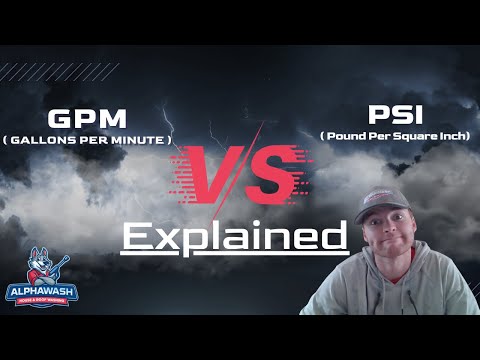
Watch This Before You Spend a Dime
A two-minute primer that will save you hundreds of dollars — and one disastrous Saturday afternoon.

The Goldilocks Zones: Matching PSI to the Job
Every surface has a sweet spot. Too little pressure and you are just rinsing. Too much and you are gouging wood, etching concrete, or stripping paint off the family minivan. Here is the field-tested breakdown.
The Gentle Zone
1,300 - 1,900 PSIBest for: Cars, motorcycles, boats, patio cushions, window screens, lawn furniture, and anything you would gently scrub with a sponge. Electric units dominate this category. Quiet, light, and forgiving.
The Sweet Spot
2,000 - 2,800 PSIBest for: Vinyl siding, wood decks, painted fences, garage doors, brick patios, and the weekly mildew that creeps over everything north of Tennessee. This is the workhorse range for 80 percent of homeowners.
The Heavy Hitter
2,800 - 3,300 PSIBest for: Concrete driveways, sealed garage floors, paint prep, stripping old stain off a deck, and that hideous oil stain your teenage driver promised would come out. Almost always gas-powered. Get hearing protection.
The Beast Mode
3,300+ PSIBest for: Professional contractors, paint and graffiti removal, commercial concrete, fleet washing. Unless you are running a side hustle, this is overkill. You will fight the recoil more than the grime.
The 18-Inch Rule Will Save Your Siding
No matter what PSI you buy, keep the nozzle at least 18 inches from any soft surface on your first pass. Move closer only if the grime laughs at you. I have seen 2,000 PSI machines blast through vinyl siding because the operator held the wand six inches from the wall. Distance is your dimmer switch. Use it.
Gas vs Electric: The Decision That Decides Everything
Before you ever land on a PSI number, you have to pick your power source. This single choice ripples through cost, noise, storage, maintenance, and the kind of jobs you can realistically tackle.
The Nozzle System: Your Secret Weapon
Here is something almost nobody mentions in the box copy: the nozzle on your wand does more to determine cleaning behavior than the engine inside. A 2,000 PSI machine with a 25-degree fan tip will out-clean a 3,000 PSI machine using a 40-degree tip. Same water, totally different result.
The Color Code Cheat Sheet
- Red (0 degrees) — A pencil-thin laser. Dangerous. Concrete and metal only. Never on wood, never on siding, never on yourself.
- Yellow (15 degrees) — Heavy-duty stripping. Paint, dried mud, caked grime.
- Green (25 degrees) — The everyday hero. Decks, driveways, siding. Use this 80 percent of the time.
- White (40 degrees) — Wide and gentle. Cars, windows, fragile surfaces.
- Black (65 degrees) — Low-pressure soap tip. For applying detergent only.
The Three Biggest Mistakes Buyers Make
Buying based on PSI alone
We covered this above, but it bears repeating because it is the number one regret post on every pressure washer forum. Always multiply PSI by GPM. If two machines are within 100 Cleaning Units of each other, the cheaper one wins.
Ignoring the hose and cord length
A 20-foot hose sounds plenty until you are dragging a 60-pound machine across the lawn every five minutes. Look for at least 25 feet of high-pressure hose and a 35-foot power cord on electric units. Trust me on this one.
Skipping the surface cleaner attachment
For about $80, a rotary surface cleaner attachment turns a 30-minute driveway job into a 7-minute one with zero streaks. If you have any concrete to clean, this is non-negotiable. The best upgrade nobody mentions.
The Final Verdict: What Should You Actually Buy?
If I could only give one recommendation to a friend who texted me from the parking lot of a big-box store, here it is:
Aim for 2,300 PSI at 1.5 GPM
That gives you 3,450 Cleaning Units — enough to demolish a season of driveway grime, deep-clean a deck, restore vinyl siding, and still gently wash the car on Sunday. It hits every job in the average suburban yard without the noise, weight, and maintenance of a gas beast. You will not regret it. You might even start volunteering to clean the neighbor's patio.
"The best pressure washer is the one you will actually pull out of the garage. A 2,300 PSI electric you use every Saturday beats a 3,500 PSI gas monster that lives behind the lawnmower."— SFPOST EDITORIAL TEAM
Buy smart, respect the wand, and your house will look like you hired a service. For half a Saturday and the price of a decent dinner out.
Now go reclaim your driveway. It has been waiting.
Key Takeaways
- Choosing the right what psi pressure washer do i need means matching the key features to your specific needs and budget
- Read real customer reviews and check the return policy before you commit
- Also covers: pressure washer psi guide
- Also covers: how much psi for driveway
- Also covers: pressure washer gpm explained
- Compare value across models — the priciest option is not always the best fit